Quick answer
Choose urethane cement if your facility sees thermal shock, daily wet washdown, hot oils, or aggressive food-grade acids — meat plants, dairies, breweries, commissary kitchens. Choose epoxy if your environment is dry, climate-controlled, and primarily handles foot and forklift traffic — warehouses, distribution centers, packaging halls, manufacturing assembly.
Both can be USDA/FDA acceptable when properly specified. The split is environmental, not regulatory.
Where urethane cement wins
Urethane cement (also called polyurethane concrete or 'PU concrete') has a thermal expansion coefficient nearly identical to concrete. That means it survives 250°F+ steam cleaning, sudden cold-water washdown, and the daily thermal cycling that destroys epoxy in wet processing environments.
- ›Thermal shock — handles 280°F steam followed by cold rinse without delaminating
- ›Chemical resistance — withstands lactic acid, animal fats, sugars, brines, and most caustic CIP cleaners
- ›Moisture tolerance — installs over green concrete (7-day cure) and high-MVT slabs that would blister epoxy
- ›Slip resistance — natural aggregate texture works well underfoot in wet areas
- ›Service life — 15–20+ years with reasonable upkeep
Where epoxy wins
Epoxy is the right call anywhere the floor stays dry, temperatures stay reasonable, and the priority is appearance, cleanability, or chemical resistance against industrial spills (oils, hydraulic fluid, mild acids).
- ›Cost — $4–$10/sf installed vs $10–$18/sf for urethane cement
- ›Aesthetics — full color range, decorative flake, quartz, metallic, logos and color-coded zones
- ›Cure time — many systems return to service in 12–24 hours
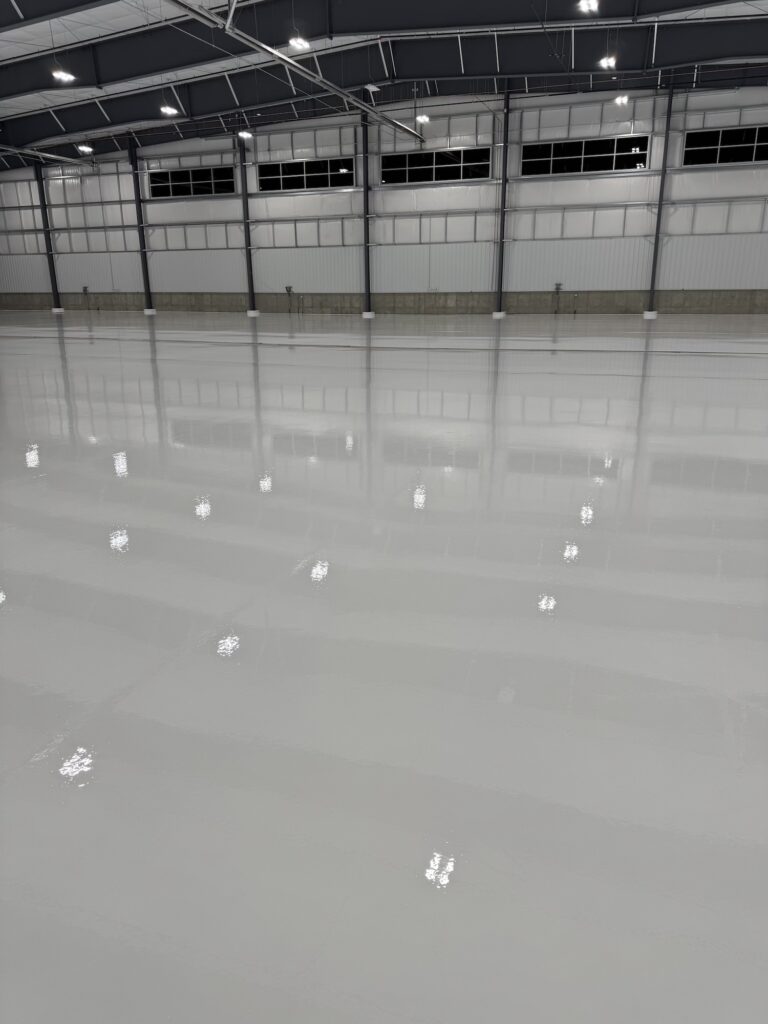
- ›Smoothness — self-leveling epoxy gives a near-glass finish that pleases facility audits
- ›Repairability — patches blend more easily than urethane cement
Side-by-side comparison
Quick reference for facility managers and specifying engineers:
- ›Max service temp — Epoxy ~140°F continuous, Urethane cement 250°F+ with steam cleaning
- ›Moisture tolerance — Epoxy poor without primer/MVT mitigation, Urethane cement excellent
- ›Aesthetics — Epoxy excellent, Urethane cement utilitarian (matte, mottled)
- ›Installed cost — Epoxy $4–$10/sf, Urethane cement $10–$18/sf
- ›Lifespan in wet processing — Epoxy 2–5 years, Urethane cement 15–20+ years
- ›Best fit — Epoxy: warehouses, packaging, dry kitchens; Urethane cement: meat, dairy, brewery, hot kitchens
Hybrid systems are increasingly common
Many large facilities don't pick one — they zone the floor. A meat processor might run urethane cement in the kill floor and process areas, then transition to high-build epoxy in the boxed-product cooler and shipping dock. Done right with proper transition details, you get the right system in every room without overspending.
We design and install both systems across the Western U.S. food, beverage, pharma, and manufacturing sectors. If you're not sure which fits your operation, send us your floor plan with process zones marked and we'll spec it room by room.